The Art of Short-Time Measurement
For almost three decades, developing and crafting chronographs has been one of A. Lange & Söhne’s prime disciplines. 13 trail-blazing timepieces with a chronograph function are testament to the ongoing further advancement of this sophisticated complication and the manufacture’s quest to explore new applications in the realm of short-time measurement.
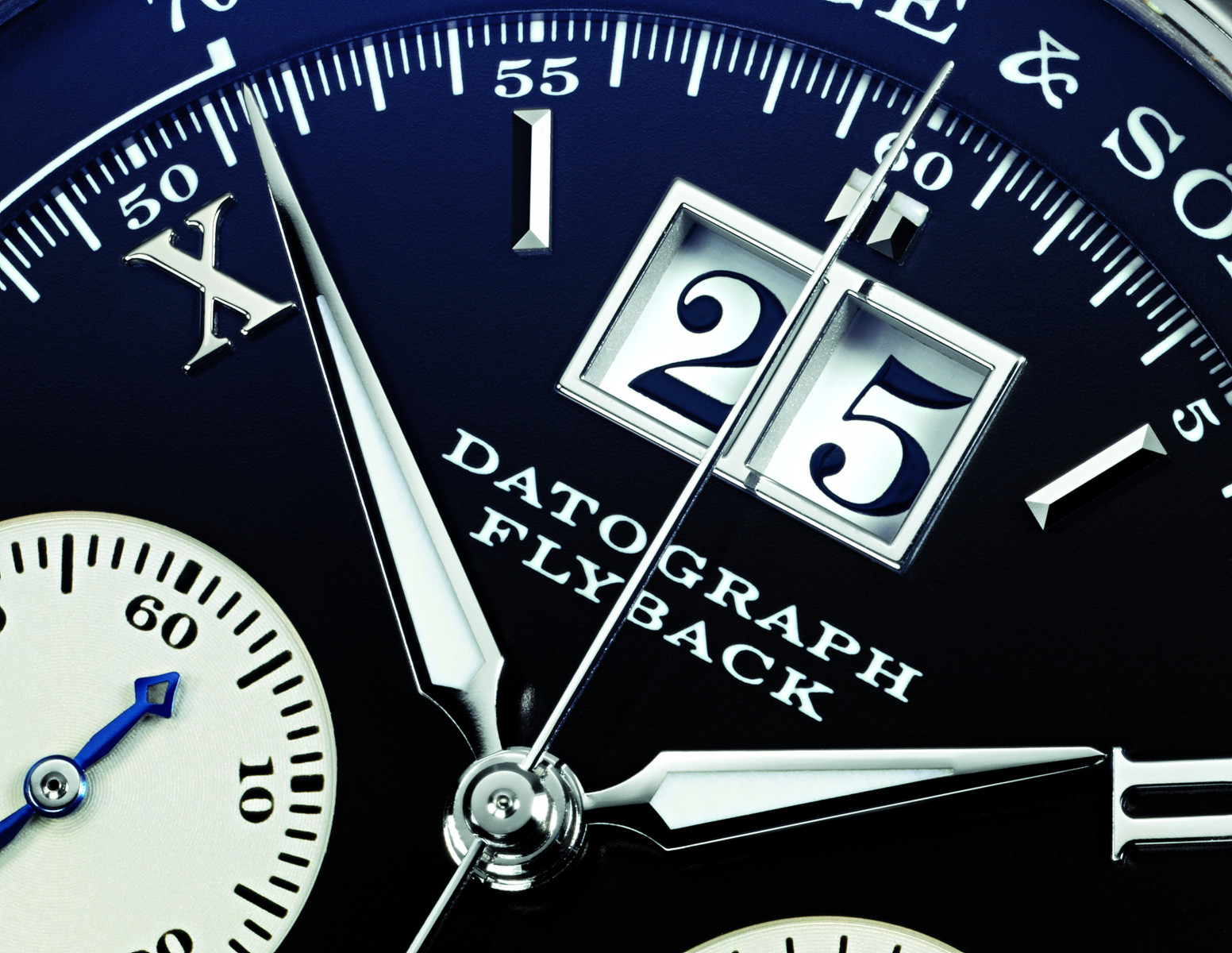
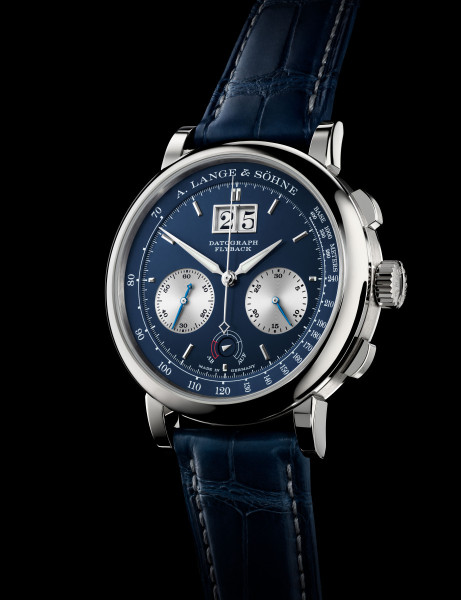
It was a milestone in modern history of precision watchmaking: in 1999, a mere five years after the launch of the first wristwatch collection following the brand’s revival, A. Lange & Söhne unveiled its first chronograph movement with the DATOGRAPH. In times when chronograph movements designed and crafted in-house were the exception, the L951.1 calibre, newly developed from the ground up, was an early indicator that it was the Saxon manufacture’s ambition to transcend horological boundaries and follow its very own path ‒ exemplified by innovative features of the timepiece which include the outsize date, the flyback function and a precisely jumping minute counter.
Select discipline: split-seconds chronographs and short-time measurement
To date, the DATOGRAPH remains the benchmark in the art of short-time measurement. Since its widely acclaimed premiere, A. Lange & Söhne has continuously expanded its expertise in the field of chronograph construction, with split-seconds chronographs occupying a special position. Across many years, the manufacture consistently evolved these, finding innovative mechanical solutions that redefined the possibilities of short-time measurement. The term rattrapante is French and designates the second “pursuing” timing hand of a chronograph. This rattrapante seconds hand can be stopped independently of the chronograph seconds hand and resynchronised with it, thus enabling comparative time measurements of up to 60 seconds with classic timepieces.
New dimensions of short-time measurement
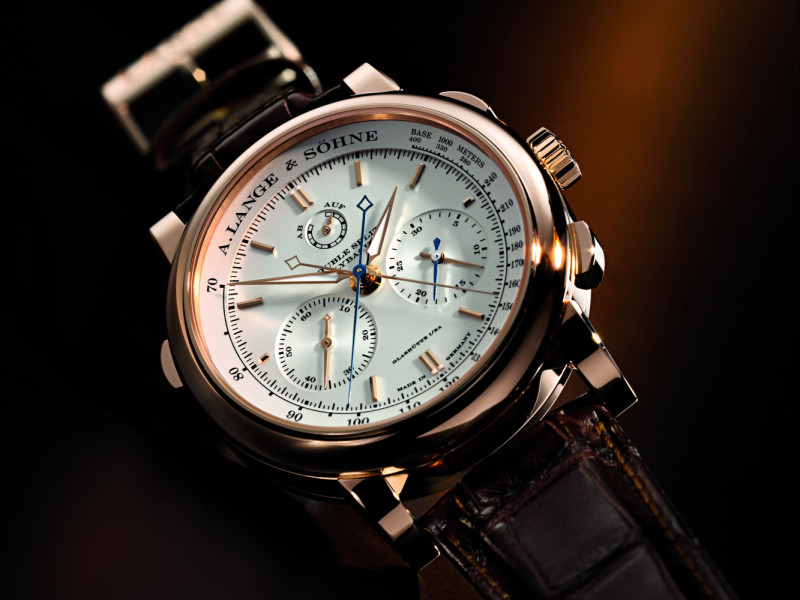
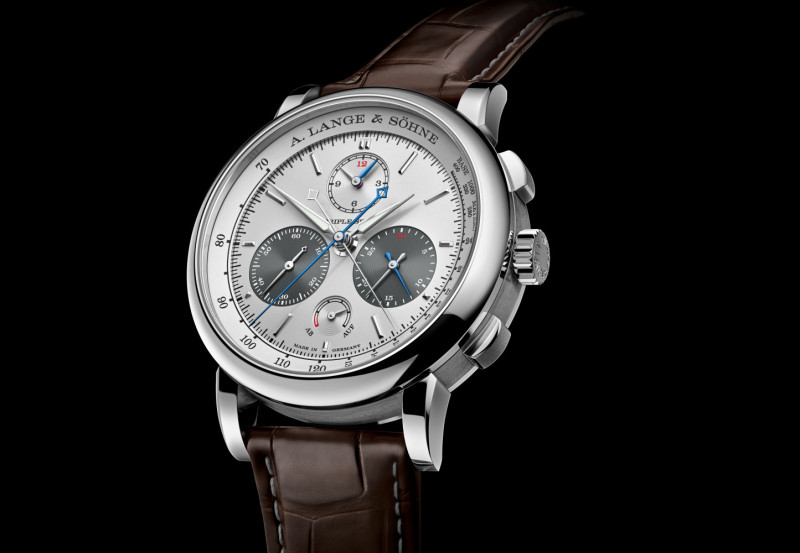
With the DOUBLE SPLIT launched in 2004, A. Lange & Söhne built a chronograph equipped with a double rattrapante ‒ a first in the history of precision watchmaking. An additional rattrapante minute counter expanded the range of intermediate and comparative measurements from 60 seconds to 30 minutes. Whereas the DOUBLE SPLIT is already unrivalled, 2018 saw the launch of the TRIPLE SPLIT, which now represents the current pinnacle in the development of the rattrapante function. Thanks to the addition of two hour counters, the chronograph and rattrapante functions can be extended to a maximum of twelve hours.
Our proprietary movements ‒ our yardstick
Instead of adapting a basic calibre for each model, every A. Lange & Söhne chronograph is endowed with a dedicated movement, which is customised to each individual design and application. In the process of developing pioneering chronographs, the Lange engineers question existing conventions and search for innovative solutions. As early as the construction stage, technical as well as aesthetic criteria are defined that distinguish the individual appearance and personality of the timepiece. The manufacture’s chronographs are based on the following four concepts that reflect A. Lange & Söhne’s particular expertise in this category.
1. Modern-classic: DATOGRAPH and 1815 CHRONOGRAPH
The DATOGRAPH model range set new standards with regard to a modern-classic chronograph. Even at first glance, the novel, well-balanced dial configuration suggests that a totally new chronograph calibre is at work within. At 12 o’clock, the outsize date in the framed double aperture marks the tip of an equilateral triangle. The auxiliary dials for the small seconds at 9 o’clock and the precisely jumping minute counter opposite at 3 o’clock, both located below the centre axis of the dial, form its base. The same design principle, however, without the outsize date, can be found in the 1815 CHRONOGRAPH.
2. Modern-sporty: ODYSSEUS CHRONOGRAPH
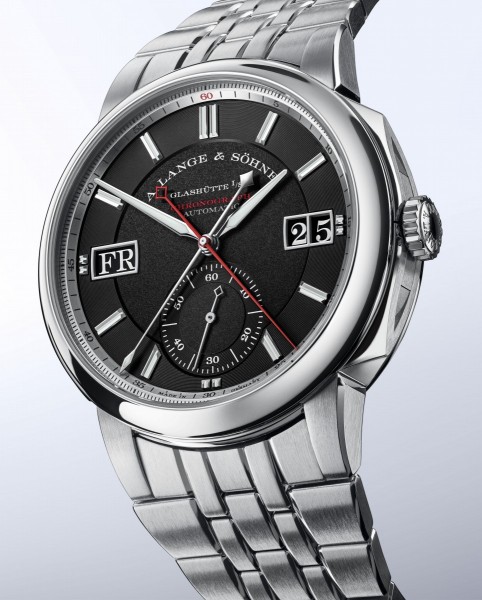
To retain the characteristic dial design of the ODYSSEUS, the Lange engineers positioned both chronograph hands in the centre – the minute counter with a lozenge-shaped tip as well as the red chronograph seconds hand. Consequently, the auxiliary dials, which are conventionally arranged at 3 and 9 o’clock, could be dispensed with, and the style-defining positions of the outsize date and day of the week could be maintained.
3. Traditional-classic: 1815 RATTRAPANTE
In terms of design and construction, the 1815 RATTRAPANTE, featuring a minute counter positioned at 12 o’clock as well as central chronograph and rattrapante seconds hands, is consistent with traditional split-seconds chronographs. The pusher at 2 o’clock starts and stops the chronograph function, whereas the pusher at 4 o’clock resets the hands to zero. This concept was also implemented in multiple complications of the 1815 watch family, such as the 1815 RATTRAPANTE PERPETUAL CALENDAR and the TOURBOGRAPH PERPETUAL “Pour le Mérite”.
4. Distinctly traditional: GRAND COMPLICATION
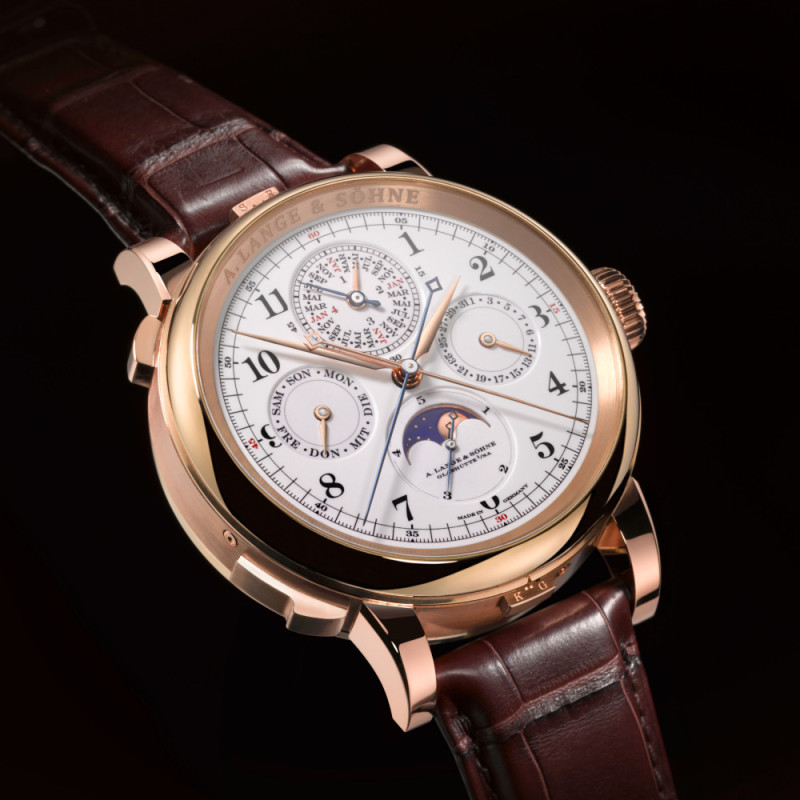
This classic arrangement can also be found in the GRAND COMPLICATION, the manufacture’s most complicated timepiece, launched in 2013. The watch represents the fourth way of realising the chronograph function. Contrary to the other three versions, operation and mechanics are based on the mono-pusher principle ‒ in tribute to the beginnings of historic chronograph construction. With the first actuation of the chronograph pusher at 2 o’clock, the time measurement is started, and stopped with the second actuation. When the pusher is pressed a third time, all chronograph hands are reset to zero.
Chronographs with additional elaborate complications
Due to its filigreed and intricate control mechanics, the chronograph function is one of the most sophisticated complications of mechanical watches. Even more elaborate and complex, though, are the timepieces that feature additional mechanisms: each one alone represents a technical feat in itself, the combination of more, however, poses an even greater challenge. This holds true for the engineers as well as the watchmakers and finishers. In 2006, A. Lange & Söhne launched the DATOGRAPH PERPETUAL ‒ the debut of a chronograph with a perpetual calendar and an outsize date. And with the TOURBOGRAPH PERPETUAL “Pour le Mérite”,
the manufacture presented the rare and ambitious combination of a split-seconds chronograph, perpetual calendar, tourbillon and fusée-and-chain transmission. Undisputedly, the GRAND COMPLICATION represents the most impressive example in this category. It bundles a host of complications: apart from grand and small strikes, a minute repeater as well as a perpetual calendar, it is equipped with a split-seconds chronograph that additionally features a flying seconds.
“Developing and crafting chronographs has played a key role in our manufacture for more than 25 years,” explains Anthony de Haas, Director of Product Development. “Every single project increased our comprehension of this sophisticated complication and yielded new insights that were assimilated into subsequent developments. The outcome: exceptional expertise, enabling us to fully customise each chronograph movement to its applications and the individual design of the watch family.”